Home CatsCaring for a Newborn Kitten until they are 8 weeks old: Complete Kitten Care, Nutrition and Growth Guide

Caring for a Newborn Kitten until they are 8 weeks old: Complete Kitten Care, Nutrition and Growth Guide

by Vetic Editorial
Published: Updated: 18.7K views
Share

Welcoming newborn kittens into your life is a heartwarming experience, but it comes with immense responsibility. Caring for a newborn kitten during the first eight weeks of a kitten’s life is crucial for their health and wellbeing. 

A newborn kitten is extremely vulnerable, and without the right care, they can quickly develop life-threatening conditions. Whether you are a first-time caregiver or an experienced cat parent, understanding the essentials of kitten care is essential to ensure that these fragile little beings grow into strong, healthy cats.

Caring for a Newborn Kitten: Week-by-Week Guide

Taking care of a newborn kitten involves several important tasks, each critical to their development. 

Below is a comprehensive week-by-week kitten-care guide to help you navigate the journey of raising a newborn kitten up to eight weeks of age.

Caring for a Newborn Kitten: Week 1 (0-7 Days Old)
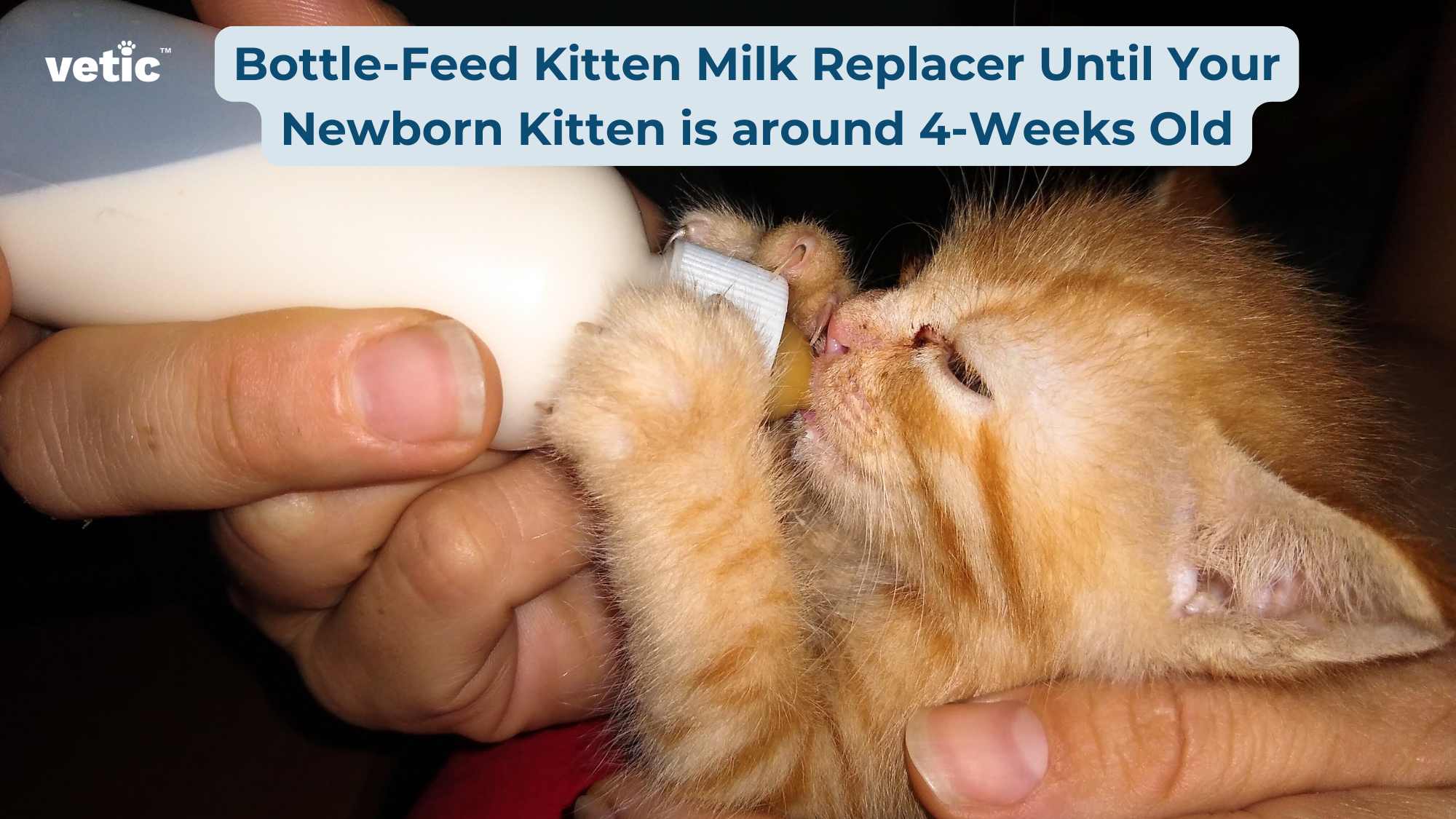
“Bottle-Feed Kitten Milk Replacer Until Your Newborn Kitten is around 4-Weeks Old.” This text provides essential advice on caring for newborn kittens who may not have access to their mother’s milk. The image features a close-up view of a small orange kitten being bottle-fed with a milk replacer. The kitten eagerly latches onto the nipple of the bottle, actively feeding. The person holding the bottle supports the kitten’s head with their hand, ensuring a comfortable feeding position. The background is blurred, emphasizing the feeding activity.

Nutrition for a Newborn Kitten:

Feeding Frequency: Newborn kittens need to be fed every 2-3 hours around the clock. Use a kitten milk replacer (KMR), as cow’s milk can cause digestive issues. Cow’s milk does not have enough fat and protein to nurture a newborn kitten.

Bottle Feeding: Ensure the kitten milk replacer is warmed to body temperature. Hold the kitten in a natural, belly-down position to feed. Allow the kitten to latch. Do not squirt the formula into their mouth since it can cause them to choke. 

Warmth for a Newborn Kitten:

Temperature Maintenance: Newborns cannot regulate their body temperature. Keep them in a warm, draft-free environment with a heating pad or warm water bottle wrapped in a towel.

Ideal Temperature: The ambient temperature should be maintained between 29°C to 32°C. It is ideal to replace the warm water bottle or hot water bag every 2 hours to maintain the desired temperature. 

Burping and Defecation:

Stimulation: After feeding, gently rub the kitten’s abdomen or back to burp them.

Encouraging Elimination: Newborn kittens cannot defecate or urinate on their own. Use a warm, damp cloth to gently stimulate the genital area to encourage urination and defecation.

Caring for a 2-Week Old Kitten (8-14 Days Old): Eyes Begin to Open

Nutrition for a 2-Week Old Kitten:

Feeding Schedule: Continue feeding every 3-4 hours. Kittens will start to consume more milk replacer as they grow, requiring larger but less frequent feedings. 

Warmth for a 2-Week Old Kitten:
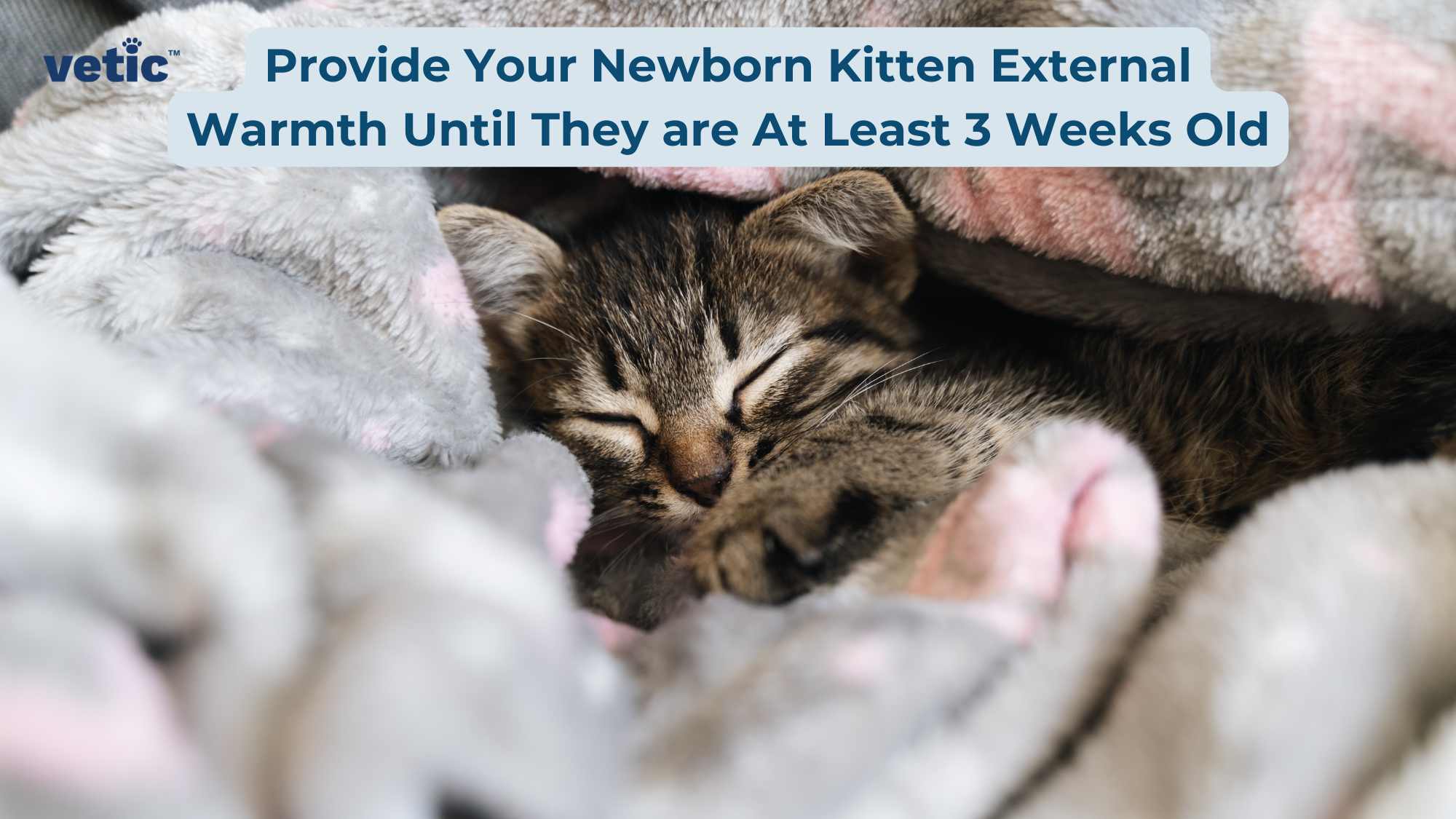
The image features a newborn kitten nestled in soft, fluffy pink and grey blankets. The kitten appears to be sleeping peacefully, with its tiny paws visible and its body mostly covered by the blankets. The image has a calming and tender quality to it. At the top of the image, there’s text in white font against a blue background that reads “Provide external warmth to your newborn kitten until they are 3 weeks or older” This suggests that the image is likely educational or informative in nature, possibly related to pet care advice. The logo “vetic” is visible in the top left corner of the image

Continued Heat Support: Maintain a warm environment, though you can slightly lower the temperature to 26°C to 30°C as they start to develop some ability to regulate body heat.

Ensuring Proper Growth of Your New Kitten:

Weighing: Weigh the kittens daily to monitor their growth. A healthy kitten should gain around 10-14 grams per day.

Milestones for a 2-Week Old Kitten:

Eyes Opening: Most kittens’ eyes begin to open when they are around 12 to 14 days old, though their vision will still be developing.

Caring for a 3-Week Old Kitten (15-21 Days Old): Gaining Strength

Nutrition for a 3-Week Old Kitten:

Feeding Schedule: Continue feeding every 4-5 hours. Ensure they are receiving adequate nutrition to support their rapid growth.

Warmth for a 3-Week Old Kitten:

Temperature Adjustment: Reduce the ambient temperature to around 26°C as they start to grow fur and regulate their body heat.

Socialisation for a 3-Week Old Kitten:
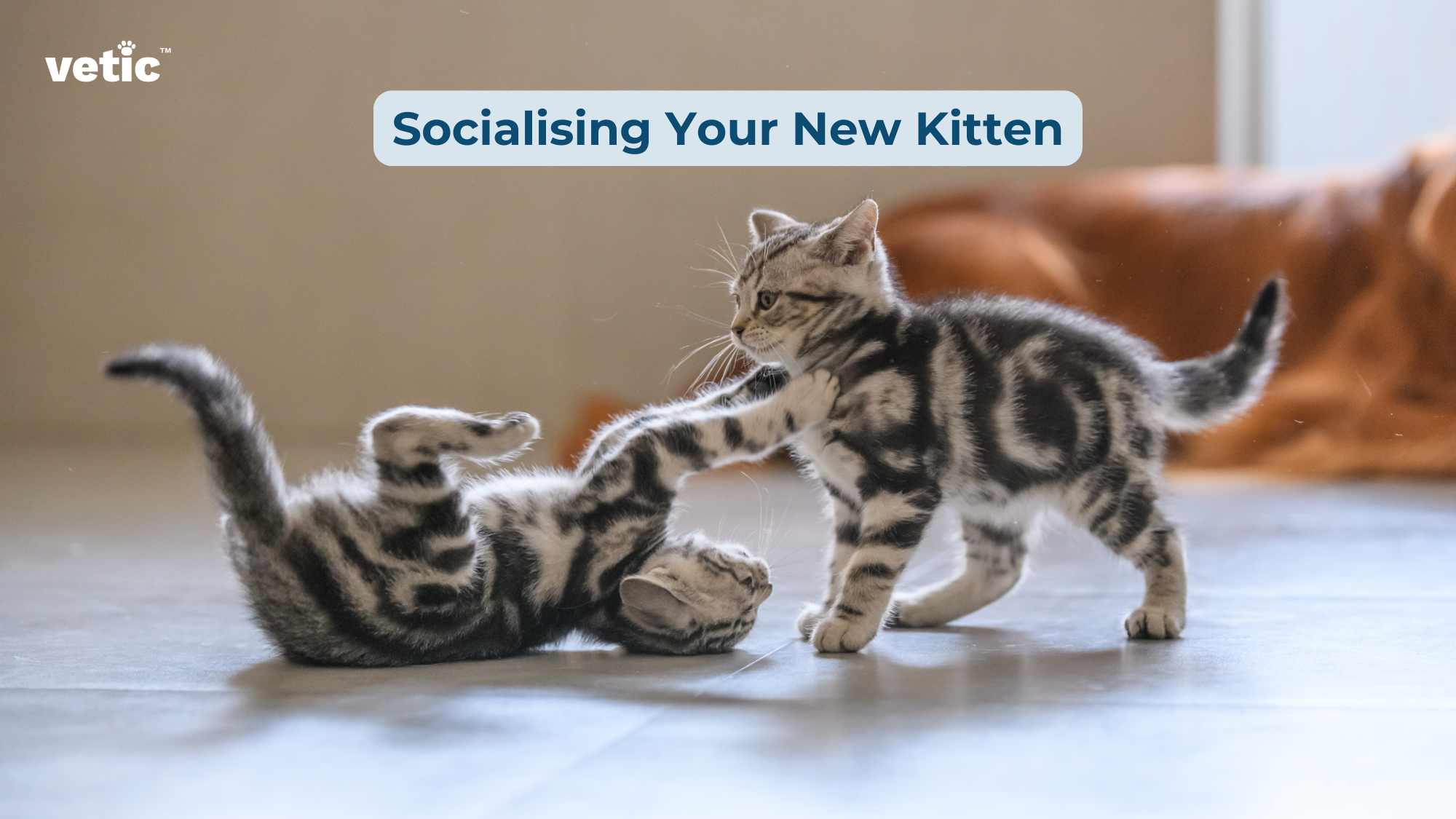
Socialising Your New Kitten.” The image features two kittens on a smooth, light-colored floor. The kitten on the left is standing and appears to be playfully swatting at the other kitten, which is lying on its back with its paws up in a defensive or playful posture. Both kittens have striped fur patterns, resembling that of a tabby cat. In the background, there’s a blurred view of what seems to be a room corner with an orange object that could be furniture.

Handling: Begin to gently handle the kittens to help them get accustomed to human contact. This is crucial for their social development.

Urination and Defecation:

Reduced Stimulation: By this stage, kittens may start to defecate on their own, but continue gentle stimulation after feeding if needed. Clean out their bedding each time they urinate or defecate on them. 

Caring for a One-Month Old Kitten (22-30 Days Old): Exploration Phase

Nutrition for a One-Month Old Kitten:

Introduction to Solid Food: Start introducing high-quality wet kitten food mixed with the milk replacer. Offer this gruel in a shallow dish. Continue bottle feeding while gradually transitioning them to solid food.

Warmth for a One-Month Old Kitten:

Temperature Maintenance: You can begin to reduce reliance on external heat sources, especially if the kittens are in a warm environment.

Socialisation and Play:

Encouraging Exploration: Kittens will start to explore their surroundings. Provide safe and stimulating toys to encourage play and movement.

Social Interaction: Continue to handle and interact with the kittens to foster social behaviour and reduce fearfulness.

Litter Training a New Kitten:
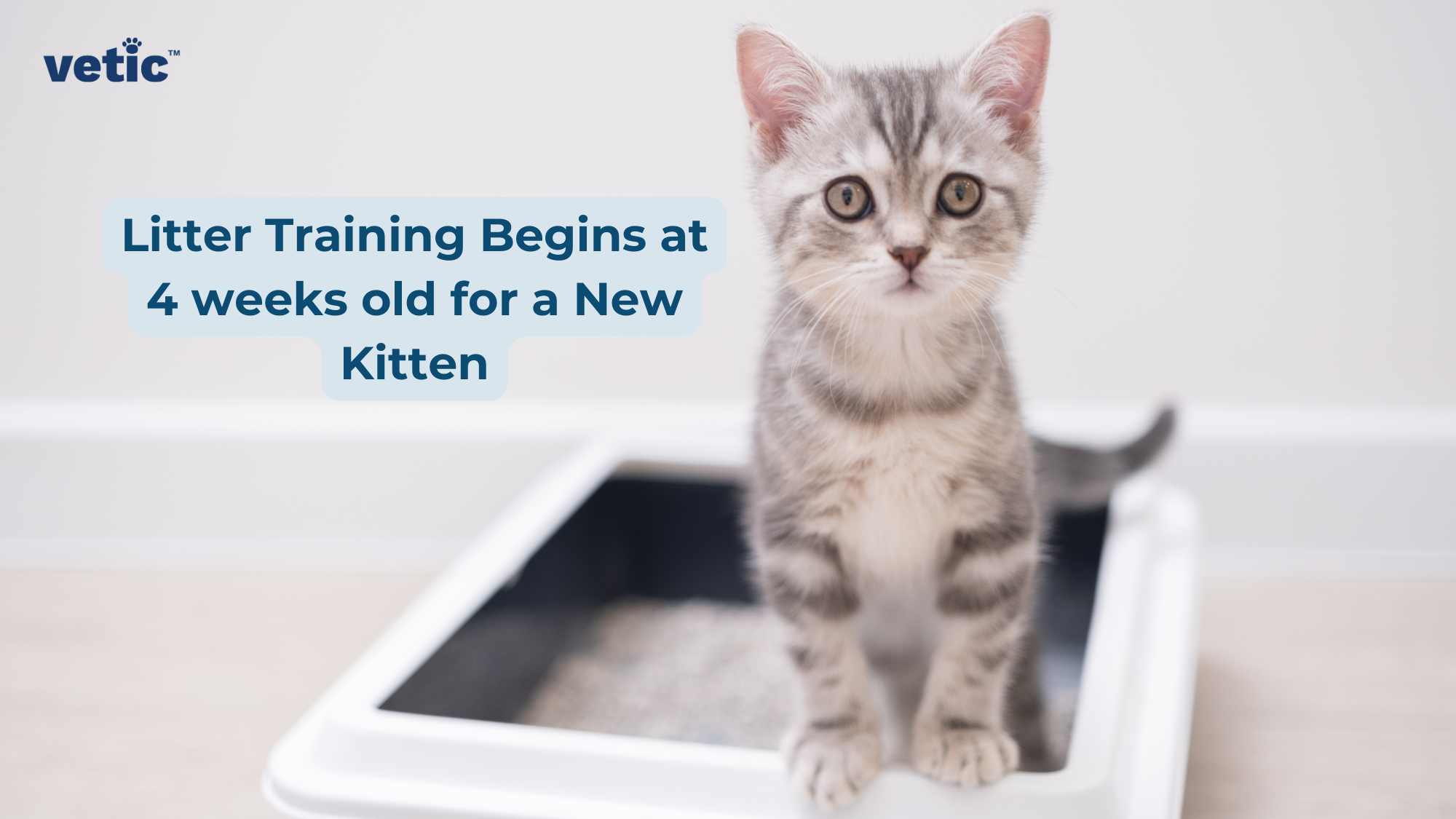
The image features a small grey and white kitten standing next to a white litter box filled with litter. The kitten has distinct tabby markings, with stripes and spots on its fur, and is looking directly at the camera with wide eyes. The background is a plain light color that provides a clear contrast to the kitten and the litter box. The heading of the image reads: “Litter Training Begins at 4 weeks old for a New Kitten.”

Introduction to Litter Box: Introduce a shallow litter box filled with non-clumping litter. Gently place the kittens in the box after meals to encourage use.

Caring for a 5-6 Weeks Old Kitten: The Weaning Process

Nutrition:

Solid Food: Gradually increase the amount of solid food and decrease bottle feeding. By the end of week 6, they should be fully weaned.

Water Intake: Ensure clean, fresh water is always available as they transition to solid food.

Growth Monitoring:
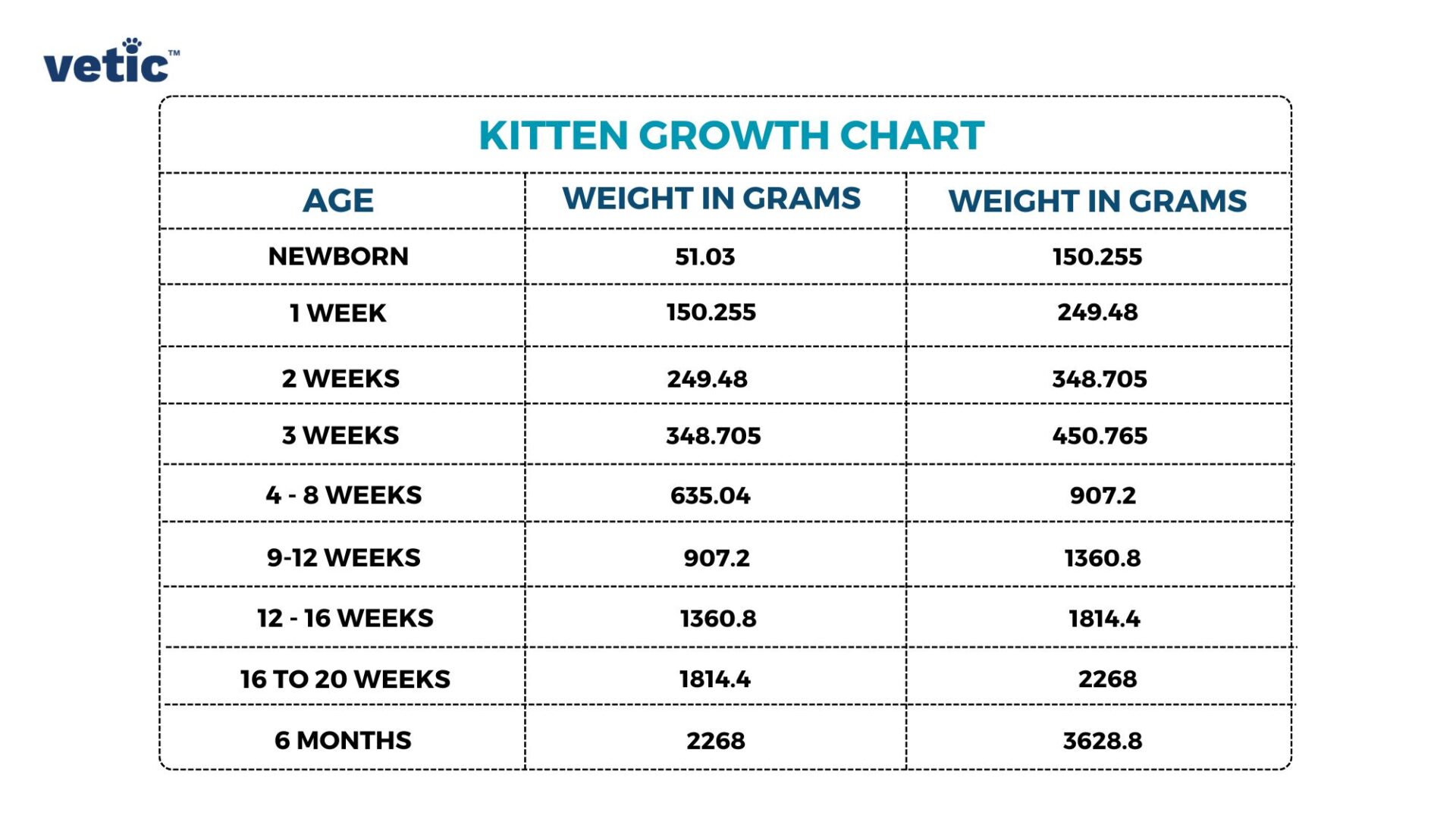
The image is a chart titled “KITTEN GROWTH CHART” made for the reference of those caring for a newborn kitten. It has the logo “vetic” at the top left corner. The chart is divided into three columns and eight rows, including the header row. The first column lists the age of kittens starting from ‘NEWBORN’ and then in weeks from ‘1 WEEK’ to ‘6 MONTHS’. The second and third columns list the weight of kittens in grams under two separate headings, both labeled ‘WEIGHT IN GRAMS’, suggesting a range of healthy weights for each age group. For a newborn kitten, the weight range is 51.03 grams to 150.255 grams. At 1 week, it’s between 150.255 grams and 249.48 grams; at 2 weeks, between 249.48 grams and 348.705 grams; at 3 weeks, between 348.705 grams and 450.765 grams; at 4-8 weeks, between 635.04 grams and 907.2 grams; at 9-12 weeks, it remains at around 907.2 grams; for kittens aged between 12-16 weeks, it ranges from around 1360.8 grams to 1814.4 grams; for those aged 16 to 20 weeks, the weight increases to 1814.4 grams on the lower end and 2268 grams on the upper end; finally, at 6 months, kittens should weigh anywhere from 2268 grams to 3628.8 grams.

Weighing: Continue to monitor their weight, ensuring consistent growth. Consult a veterinarian if you notice any issues with weight gain.

Socialisation:

Playtime: Encourage interactive play to develop their motor skills and social behavior. This is also a critical time for bonding with humans.

Deworming and Vaccination:
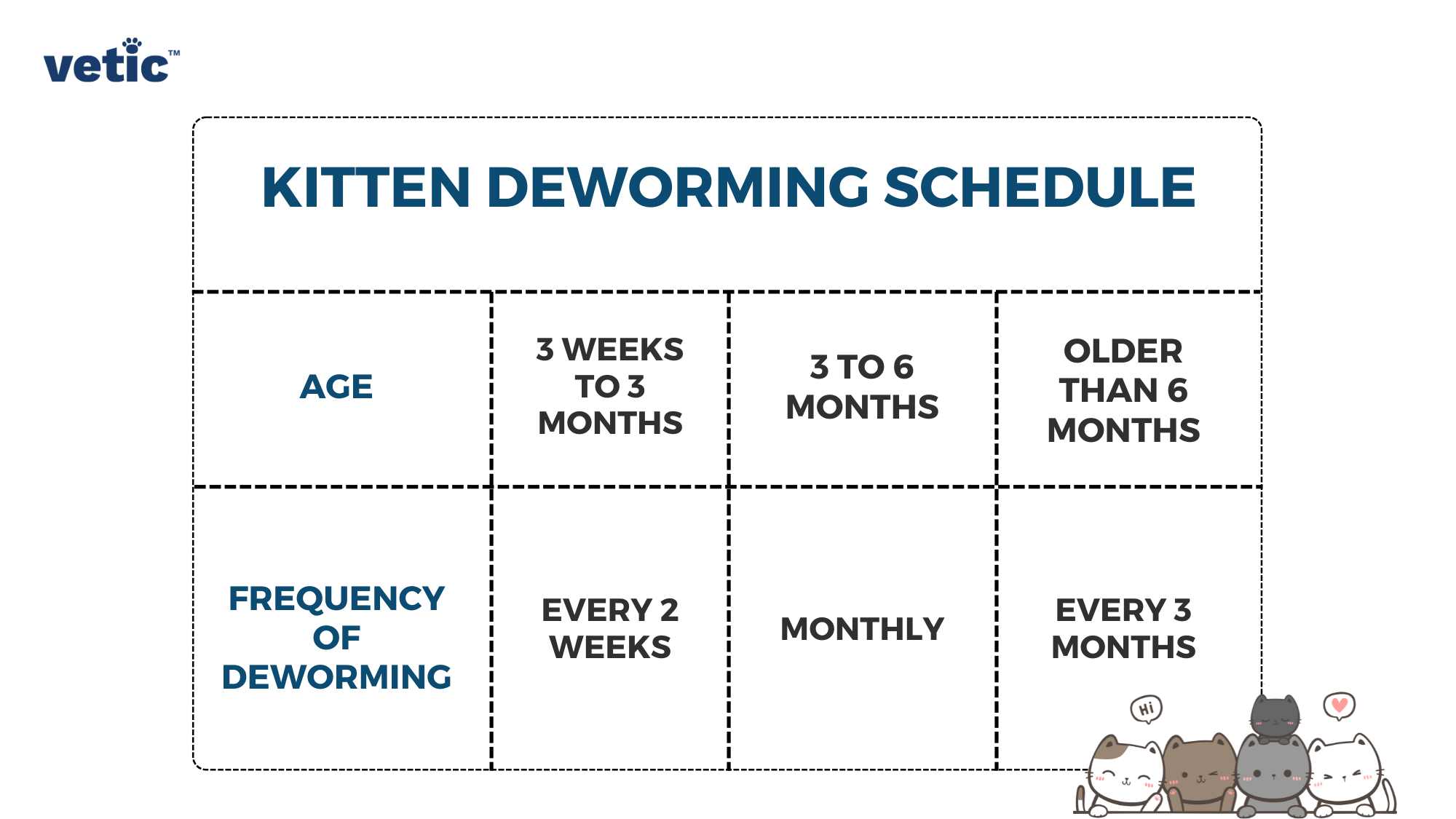
“KITTEN DEWORMING SCHEDULE” with the logo “vetic” at the top. The chart is divided into three columns under the headings “AGE,” “FREQUENCY OF DEWORMING,” and a row of illustrations of five kittens at the bottom. The first column lists three age groups: “3 WEEKS TO 3 MONTHS,” “3 TO 6 MONTHS,” and “OLDER THAN 6 MONTHS.” Corresponding to these age groups, the second column indicates the frequency of deworming as “EVERY 2 WEEKS,” “MONTHLY,” and “EVERY 3 MONTHS” respectively.

First Deworming: Kittens should receive their first deworming treatment around 4-6 weeks of age.

First Vaccination: Consult your veterinarian about the first vaccination, usually administered around 6-8 weeks of age.

Caring for a 6-8 Weeks Old Kitten: Becoming Independent

Nutrition:

Solid Food: Kittens should now be fully on solid food. Ensure they are eating high-quality kitten food that meets their nutritional needs. Do not feed them adult food or they won’t receive the necessary nutrients. 

Water and Hydration: Continue to provide access to fresh water at all times. Monitor the quantity of water they are drinking. When they are eating wet food, they might drink less water

Health Care:

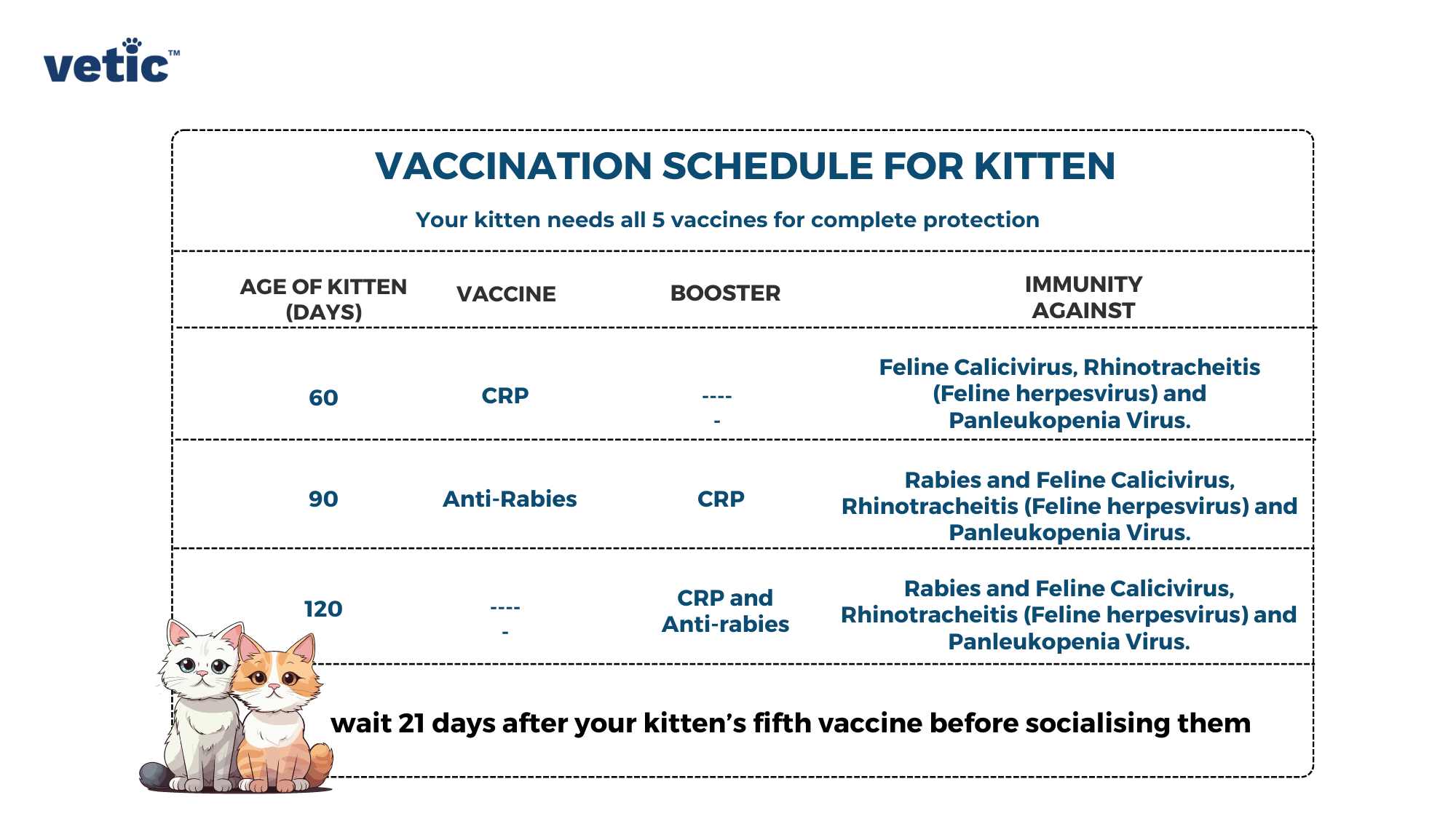
The image features a vaccination schedule chart for kittens, titled “VACCINATION SCHEDULE FOR KITTEN” with the subtitle “Your kitten needs all 5 vaccines for complete protection.” The chart is divided into four columns: Age of Kittens (Days), Vaccine, Booster, and Immunity Against. There are three rows detailing the age at which each vaccine should be administered: 60 days, 90 days, and 120 days. The vaccines listed are Feline Herpesvirus and Calicivirus, Panleukopenia Virus, and Rabies. Boosters for Feline Herpesvirus and Calicivirus are mentioned at 90 days and Anti-rabies at 120 days. The immunity provided by these vaccines includes protection against Feline Herpesvirus, Calicivirus, Panleukopenia Virus, Rabies (Feline Herpesvirus), and Rabies (Feline Calicivirus). At the bottom of the chart is a note stating to wait 21 days after your kitten’s last vaccine before socializing them.

Vaccinations: Follow up with your veterinarian on the vaccination schedule. Kittens typically receive their first round of vaccinations at 6-8 weeks.

Deworming: A second round of deworming may be required at this stage.

Socialisation and Independence:

Exploration: Kittens will be much more active and curious. Provide them with a safe environment to explore and play. Do not take your kitten outdoors until they have received all doses of their vaccines. 

Social Behavior: Continue to handle them gently and expose them to different household sounds and experiences to build their confidence.

Litter Training:

Independence: By now, kittens should be fully litter trained. Keep their litter box clean and accessible.

You Must Remember This While Caring for a Newborn Kitten

Taking care of newborn kittens up to eight weeks of age is a demanding task that requires time, patience, and dedication. 

Each stage of their development brings new challenges and responsibilities. From feeding and warmth to socialisation and health care, every aspect of kitten care plays a crucial role in ensuring they grow into healthy, well-adjusted cats. 

It’s important to remember that raising kittens is not an easy job—it may take more than one person to provide the necessary care and attention. If you’re ever in doubt, don’t hesitate to seek help from a veterinarian or experienced caregiver. 

Your efforts in these early weeks will lay the foundation for a lifetime of health and happiness for your furry little companions.

Want to know more about pets?

Popular Searches

Consultation for Dog Near Me | About Us | Grooming for Dog Near Me | Vaccination for Dog Near Me | Surgery for Dog Near Me | Emergency Care for Dog Near Me | Consultation for Cat Near Me | Grooming for Cat Near Me | Vaccination for Cat Near Me | Surgery for Cat Near Me | Emergency Care for Cat Near Me | Pet Clinic in Gurgaon | Pet Clinic in Delhi | Pet Clinic in Hyderabad | Pet Clinic in Mumbai | Pet Clinic in Chennai | Pet Clinic in Noida | Pet Clinic in Ghaziabad | Pet Clinic in Bangalore | Pet Clinic in Pune | Pet Clinic in Faridabad | Pet Clinic in Kolkata | Pet Consultation in Gurgaon | Pet Consultation in Bangalore | Pet Consultation in Chennai | Pet Consultation in Delhi | Pet Consultation in Hyderabad | Pet Consultation in Mumbai | Pet Consultation in Ghaziabad | Pet Consultation in Pune | Pet Consultation in Faridabad | Pet Consultation in Noida | Pet Consultation in Kolkata | Pet Grooming in Bangalore | Pet Diagnostics in Bangalore | Pet Surgery in Delhi | Pet Emergency Care in Mumbai | Pet Clinic in Golf Course Road, Gurgaon | Pet Clinic in Sector 45, Gurgaon | Pet Clinic in Sohna Road, Gurgaon | Pet Clinic in Galleria Market, Gurgaon | Pet Clinic in Sector 57, Gurgaon | Pet Clinic in Sector 82, Gurgaon | Pet Clinic in Greater Kailash, Delhi | Pet Clinic in Pitampura, Delhi | Pet Clinic in Sector 11, Delhi | Pet Clinic in Defence Colony, Delhi | Pet Clinic in Malviya Nagar, Delhi | Pet Clinic in Anand Vihar, Delhi | Pet Clinic in Vasant Kunj, Delhi | Pet Clinic in Hitec City, Hyderabad | Pet Clinic in Secunderabad, Hyderabad | Pet Clinic in Manikonda, Hyderabad | Pet Clinic in Banjara Hills, Hyderabad | Pet Clinic in Kukatpally, Hyderabad | Pet Clinic in Kandivali, Mumbai | Pet Clinic in Thane West, Mumbai | Pet Clinic in Andheri West, Mumbai | Pet Clinic in Chembur, Mumbai | Pet Clinic in Sanpada, Mumbai | Pet Clinic in Mira Road, Mumbai | Pet Clinic in Borivali, Mumbai | Pet Clinic in Powai, Mumbai | Pet Clinic in Banerghatta, Bangalore | Pet Clinic in HSR Layout, Bangalore | Pet Clinic in Domlur, Bangalore | Pet Clinic in Kalyan Nagar, Bangalore | Pet Clinic in Whitefield, Bangalore | Pet Clinic in Sadashiva Nagar, Bangalore | Pet Clinic in Nagarbhavi, Bangalore | Pet Clinic in Electronic City, Bangalore | Pet Clinic in Banashankari, Bangalore | Pet Clinic in Yelahanka, Bangalore | Pet Clinic in Sarjapur Road, Bangalore | Pet Clinic in Koramangala, Bangalore | Pet Clinic in Aundh, Pune | Pet Clinic in Kalyani Nagar, Pune | Pet Clinic in NIBM, Pune | Pet Clinic in Wakad, Pune | Pet Clinic in Sector 20, Noida | Pet Clinic in Sector 49, Noida | Pet Clinic in Indirapuram, Ghaziabad | Pet Clinic in Sector 14, Faridabad | Pet Clinic in Salt Lake, Kolkata | Pet Clinic in Anna Nagar, Chennai | Veterinary Hospital Near Me | Pet Clinic Near Me | Vet Near Me | Pet Grooming Clinic Near Me | Pet Cancer Treatment Near Me | Pet Grooming in Chennai | Pet Grooming in Delhi | Pet Grooming in Gurgaon | Pet Grooming in Hyderabad | Pet Grooming in Mumbai | Pet Grooming in Ghaziabad | Pet Grooming in Pune | Pet Grooming in Faridabad | Pet Grooming in Noida | Pet Grooming in Kolkata | Pet Diagnostics in Chennai | Pet Diagnostics in Delhi | Pet Diagnostics in Gurgaon | Pet Diagnostics in Hyderabad | Pet Diagnostics in Mumbai | Pet Diagnostics in Ghaziabad | Pet Diagnostics in Pune | Pet Diagnostics in Faridabad | Pet Diagnostics in Noida | Pet Diagnostics in Kolkata | Pet Surgery in Bangalore | Pet Surgery in Chennai | Pet Surgery in Gurgaon | Pet Surgery in Hyderabad | Pet Surgery in Mumbai | Pet Surgery in Ghaziabad | Pet Surgery in Pune | Pet Surgery in Faridabad | Pet Surgery in Noida | Pet Surgery in Kolkata | Pet Emergency Care in Bangalore | Pet Emergency Care in Chennai | Pet Emergency Care in Gurgaon | Pet Emergency Care in Hyderabad | Pet Emergency Care in Ghaziabad | Pet Emergency Care in Pune | Pet Emergency Care in Faridabad | Pet Emergency Care in Noida | Pet Emergency Care in Kolkata
“Bottle-Feed Kitten Milk Replacer Until Your Newborn Kitten is around 4-Weeks Old.” This text provides essential advice on caring for newborn kittens who may not have access to their mother’s milk. The image features a close-up view of a small orange kitten being bottle-fed with a milk replacer. The kitten eagerly latches onto the nipple of the bottle, actively feeding. The person holding the bottle supports the kitten’s head with their hand, ensuring a comfortable feeding position. The background is blurred, emphasizing the feeding activity.

    Consult A Vet

    Book An Appointment


    image
    Call A Vet
    ×

      Consult A Vet

      Book An Appointment